
How Crystals Form and Transmit Energy in Healing
A crystal looks still, but inside it is highly ordered. Its atoms repeat in a precise pattern, creating structures that can bend light, hold colour, respond to pressure, and in some cases conduct or generate electrical charge.
That is one reason crystals sit in two worlds at once. They belong to geology and physics, but they also have a long place in healing traditions, meditation, protection rituals, and energy work. Quartz can help a watch keep time. A piezoelectric crystal in a lighter can help create a spark. In holistic practice, the same idea of energy transfer is used more gently, through touch, intention, placement, and ritual.
This article looks at both sides: how crystals form in nature, how some transmit energy through known physical effects, and how healers understand their interaction with the human energy field.
What crystals are
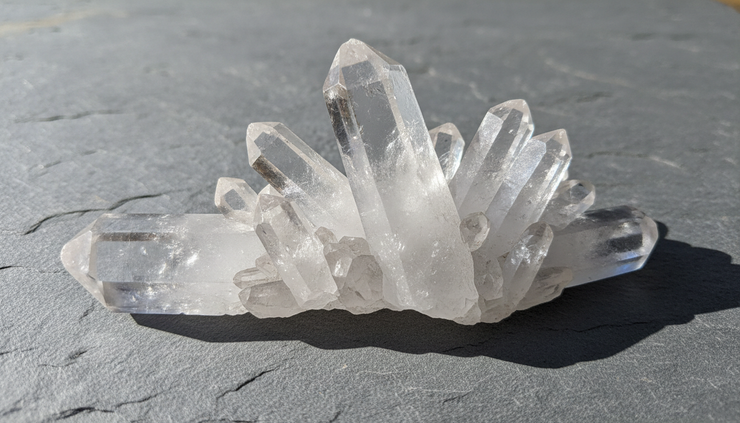
A crystal is a solid material with atoms, ions, or molecules arranged in a repeating pattern. This internal pattern is called a crystal lattice. It gives each crystal its shape and many of its physical qualities.
Quartz, for example, is made from silicon and oxygen atoms arranged in a highly ordered structure. Its natural form often appears as six-sided points. Other crystals form cubes, plates, needles, clusters, or layered sheets, depending on their chemistry and growth conditions.
This structure matters because it affects how a crystal behaves. It can influence:
how the crystal reflects or bends light
how hard or soft it is
how it breaks
how it reacts to heat or pressure
whether it can carry or create electrical charge
Not every beautiful mineral is a crystal in the strict scientific sense, and not every crystal is rare or colourful. Salt, snowflakes, and sugar can all form crystals. Gemstones such as amethyst, citrine, tourmaline, and rose quartz are better-known examples used in jewellery and healing.
How crystals form in the Earth
Crystals form when atoms have the right conditions to arrange themselves into a stable repeating pattern. This can happen in several ways, often over long periods of time.
Crystals grow from cooling molten rock
Deep within the Earth, molten rock contains many different elements. As it cools, atoms begin to bond and settle into crystal structures. Slow cooling gives atoms more time to arrange themselves, which can produce larger crystals. Faster cooling often creates smaller crystals because the structure has less time to grow.
Granite is a familiar example. It contains visible crystals of quartz, feldspar, and mica, formed as molten material cooled underground.
Crystals form from mineral-rich water
Many crystals grow from water carrying dissolved minerals. When the water moves through cracks in rock, cools, evaporates, or changes pressure, the minerals can settle out and crystallise.
Quartz veins often form this way. Mineral-rich fluids move through fractures, then leave behind silica as conditions change. Over time, this silica can grow into quartz points, clusters, or massive forms.
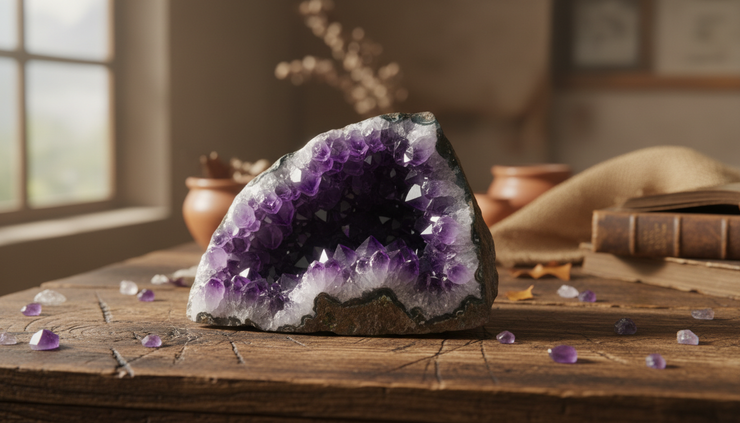
Amethyst, a purple variety of quartz, can form inside hollow spaces in rock. These spaces, known as geodes, allow crystals to grow inward from the walls. Trace elements and natural radiation influence the purple colour.
Crystals form through heat and pressure
Some minerals change when rocks face intense heat and pressure underground. These conditions can rearrange atoms and create new crystal structures without fully melting the rock.
This process, called metamorphism, helps form minerals such as garnet, kyanite, and some types of mica. It shows that crystals are not fixed objects from the start. They are shaped by their environment.
Colour comes from chemistry and structure
The colour of a crystal often comes from trace elements, structural defects, or the way the crystal absorbs light.
For example:
Crystal | Common colour | What often influences the colour |
Amethyst | Purple | Iron traces and natural irradiation |
Citrine | Yellow to golden | Iron and heat-related changes |
Rose quartz | Pink | Tiny inclusions and structural effects |
Black tourmaline | Black | Iron-rich composition and complex structure |
Clear quartz | Colourless | A relatively pure structure with few colour-causing inclusions |
In crystal healing, colour also carries symbolic meaning. Purple is often linked with spiritual awareness, pink with the heart, black with protection, and clear with cleansing or amplification.
How crystals transmit energy
The phrase “crystals transmit energy” can mean different things depending on context.
In physics, energy transfer can be measured through heat, light, electricity, vibration, or pressure. In healing traditions, energy often refers to subtle qualities felt through the body, emotions, intention, and personal awareness.
Both uses need to be kept clear. The scientific effects are measurable. The healing effects are personal, experiential, and not a replacement for medical care.
The piezoelectric effect in quartz
Quartz is one of the best-known piezoelectric crystals. Piezoelectricity means that certain crystals can convert mechanical energy into electrical energy, and electrical energy into mechanical movement.
When pressure is applied to a piezoelectric crystal, the crystal’s internal charge distribution shifts. This can create an electrical voltage. When electrical current is applied, the crystal can change shape or vibrate.
This is not just an idea. It is used in everyday objects.
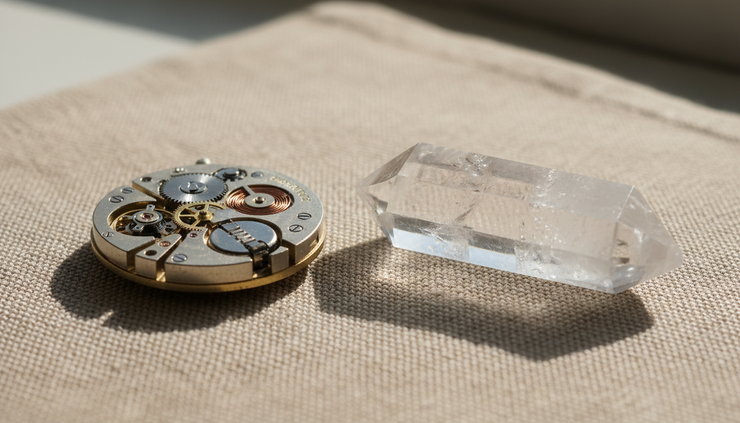
A quartz watch uses a tiny quartz crystal. A battery sends electrical energy into the quartz, causing it to vibrate at a steady rate. The watch uses those vibrations to keep accurate time. In simple terms, it converts electrical energy into mechanical vibration.
A piezoelectric lighter works the other way round. Pressing the button applies mechanical force to a piezoelectric material. That pressure creates a high voltage, producing a spark that lights the gas. In this case, it converts mechanical energy into electrical energy.
Engineering research, including work discussed by authors such as Covaci and Gontean, and Zhang and colleagues, explores these piezoelectric effects in technical settings. The key point is clear: some crystals can act as bridges between pressure, electricity, and vibration.
Why the crystal lattice matters
Piezoelectric materials have internal structures that respond unevenly to stress. When they are squeezed, stretched, or electrically stimulated, their charged particles do not shift in exactly the same way in every direction.
Quartz has a trigonal crystal structure often seen outwardly as hexagonal points. This ordered geometry helps explain why it can respond so reliably to electrical and mechanical forces.
That reliability is why quartz appears in watches, sensors, microphones, scientific instruments, and electronic components. Its energy-transmitting role is not vague in those cases. It is built into the device.
The human body also produces energy fields
The human body runs on chemistry and electricity. Nerve signals, heart rhythms, muscle movement, brain activity, and cell communication all involve electrical changes. The heart and brain also produce measurable electromagnetic fields, which medical tools can detect in specific ways.
In holistic healing, this wider pattern is often called the human biofield or human energy field. Practitioners may describe it as a subtle field that reflects physical, emotional, mental, and spiritual balance.
From a scientific view, the body’s electrical activity is real. The broader idea that crystals directly regulate a human biofield is harder to measure and remains outside mainstream medical proof. Still, many people use crystals as supportive tools for grounding, meditation, relaxation, emotional focus, and intention setting.
That distinction matters. Crystal healing can be meaningful as a complementary wellbeing practice, but it should not replace medical diagnosis, treatment, or mental health support.
How crystal healing is understood
In crystal healing, the body is seen as an energetic system. Everything is understood as vibrating at particular frequencies, including thoughts, emotions, organs, and minerals. When a person holds or wears a crystal, practitioners believe an energy exchange can take place.
The aim is not usually to “force” the body into change. It is to support balance. A crystal may be chosen for its colour, structure, tradition, felt sensation, or symbolic meaning. It may be placed on a specific part of the body, held during meditation, worn as jewellery, or kept nearby during rest.
Common intentions include:
calming the mind
grounding scattered energy
supporting emotional release
encouraging protection
strengthening focus
deepening meditation
creating a sense of spiritual connection
People often report that crystals help them slow down, breathe more deeply, and focus inward. Some of that benefit may come from ritual, attention, and expectation. Some practitioners understand it as subtle energy exchange. Both views can sit beside each other if claims stay careful and personal.
Why different coloured crystals are used differently
Colour plays a strong role in crystal healing. While the geology of colour may come from chemistry, the healing meaning comes from tradition, intuition, and symbolic association.
Black crystals, such as black tourmaline, are often used for protection and grounding. Many practitioners believe black tourmaline can absorb or deflect negative energy, including emotional heaviness and electromagnetic stress from devices. This is a traditional or energetic belief rather than a proven shield against electromagnetic fields.
Clear quartz is often called an amplifier. It is used to bring clarity, strengthen intention, and support other crystals. Its real-world role in electronics also gives it a special place in modern crystal healing.
Rose quartz is associated with the heart, compassion, and emotional softness. Amethyst is linked with calm, intuition, and spiritual connection. Citrine is often used for confidence, warmth, and creativity.
Here is a simple guide to common uses:
Crystal | Traditional healing association | Common placement or use |
Clear quartz | Clarity, amplification, cleansing | Held during meditation or placed with other crystals |
Rose quartz | Love, compassion, emotional healing | Near the heart or beside the bed |
Amethyst | Calm, intuition, spiritual awareness | On the forehead area or in a meditation space |
Black tourmaline | Protection, grounding, energetic clearing | Near the feet, doorway, or electronic devices |
Citrine | Positivity, confidence, creative energy | On a desk, altar, or in a pocket |
How crystals are programmed with intention
Programming a crystal means linking it with a clear purpose. In healing traditions, this attunes the crystal’s energy to a chosen intention, such as protection, healing, peace, angelic connection, or confidence.
A simple programming practice can be gentle and grounded.
Choose the crystal
Select a crystal that feels right for the intention. This may be based on its traditional meaning, colour, shape, or simply how it feels in the hand.
Clear the crystal
Many people like to clear a crystal before programming it. Common methods include placing it in moonlight, using sound, holding it with steady breath, or visualising clear light around it.
Be careful with water and salt. Some crystals can dissolve, rust, fade, or become damaged.
Hold it and focus
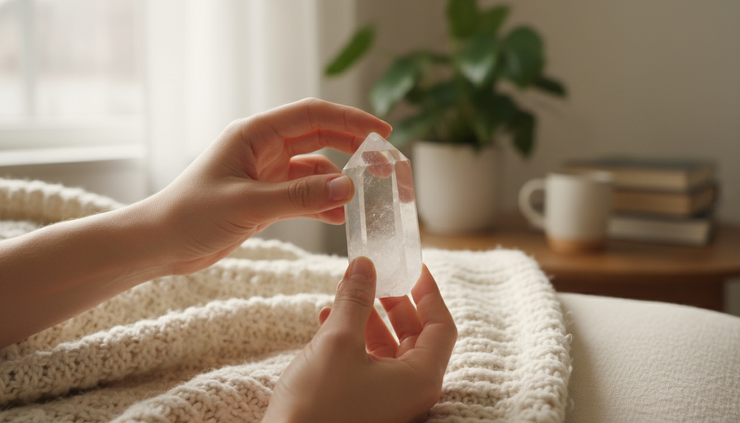
Sit somewhere quiet. Hold the crystal in both hands or place it near the heart. Notice its weight, texture, temperature, and shape. Let the breath slow.
Visualise the crystal filled with clear, bright light. Some people imagine the light flowing between the crystal and the body.
State the intention
Use a short affirmation. Speak it aloud or silently.
Examples include:
“I programme this crystal for calm, protection, and balance.”
“May this crystal support healing and gentle release.”
“I connect this crystal with love, clarity, and angelic guidance.”
“I ask this crystal to help me feel grounded and safe.”
The words matter less than the focus behind them. Keep the intention positive, clear, and present.
Detach and return to the room
When the practice feels complete, thank the crystal in your own way. Imagine the energy settling into the crystal. Then bring awareness back to the body, the floor, and the room. This helps create a safe ending rather than leaving the mind feeling floaty or ungrounded.
How to use crystals safely and meaningfully
Crystal healing works best when it supports daily wellbeing rather than replacing practical care. It can sit alongside rest, breathwork, journalling, prayer, meditation, therapy, gentle movement, and time in nature.
A grounded crystal practice might include:
holding black tourmaline while breathing slowly after a stressful day
placing rose quartz near the heart during self-compassion meditation
using clear quartz while setting a clear intention for the week
keeping amethyst near a quiet reading or reflection space
carrying a small grounding stone in a pocket as a reminder to pause
Treat the crystal as a focus point. The act of choosing it, holding it, and setting an intention can shift attention away from stress and towards steadiness.
If symptoms are physical, severe, persistent, or worrying, seek advice from a qualified health professional. Crystals may support comfort and reflection, but they do not diagnose illness or replace medical treatment.
The link between science and healing tradition
The science of crystals shows that structure matters. Quartz can vibrate with precision. Piezoelectric materials can turn pressure into voltage and voltage into movement. Crystal lattices can shape light, colour, hardness, and electrical behaviour.
Healing traditions take a wider view. They see crystals as energetic allies that interact with the body’s subtle field through vibration, intention, colour, and placement. This is not the same kind of claim as a quartz watch or a piezoelectric lighter. It belongs to lived experience, ritual, and spiritual practice.
The most balanced view holds both with care. Crystals are real geological structures with measurable physical properties. They are also meaningful objects that people use for focus, comfort, protection, and healing intention.
When a crystal is held with awareness, it can become a reminder to breathe, settle, and return to balance. Whether understood through physics, symbolism, or subtle energy, that moment of connection is often where the healing practice begins.


Comments